
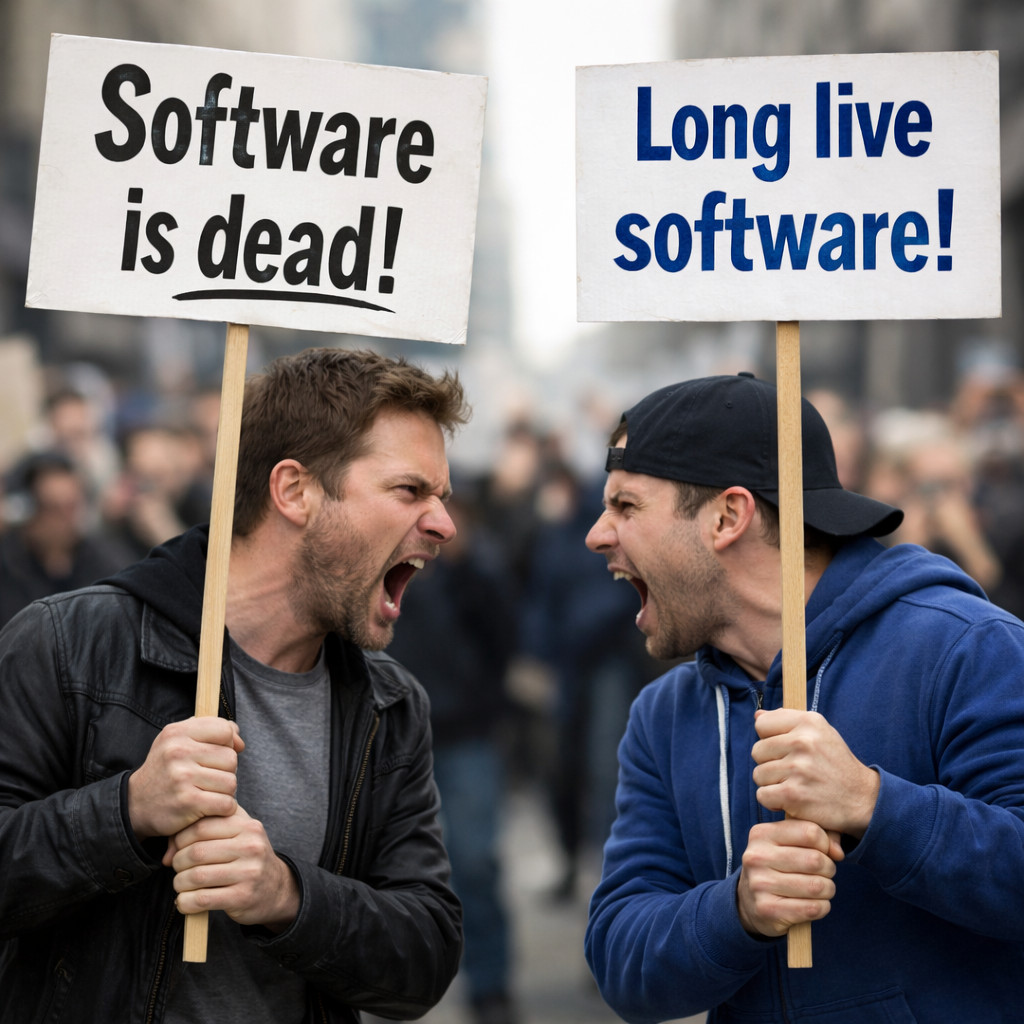
A lot of people make predictions about AI and what’s going to happen. It’s an especially fun pastime in December/January. But predictions are hard, and it’s always refreshing to me when someone admits the truth. That is, that when it comes to AI, no one has any idea where it’s all going.
Including me.
If you disagree and think that pundits or the market or experts or conventional wisdom can make accurate predictions, then just stop reading here and read Steven Sinofsky’s (of a16z) opinion post: Death of Software. Nah. where he reviews predictions over the past 30+ years of tech:
Every great technological innovation was certainly the “death of something” and that death was imminent.
- But nothing died, it just morphed
- The markets and people and most businesses adapted to the new thing
- It wasn’t imminent at all; it took a long time for the full impact to be felt
- The sectors survived, although (as to be expected) some companies didn’t
Will this time be any different? It could be. But probably not.
Anyway.
Unless you slept through last week, you know that the AI world has been talking about two things. Moltbook (Reddit for AI agents), and how AI is so good at programming that software is obsolete. Moltbook is much less important so I’ll cover it second.
AI Eats Software
Last week the stock market for software companies had a meltdown – particular SaaS software companies – after some product releases from Anthropic that seem to encroach on the traditional software business model.Check out the S&P 500 Software & Services Index over the last six months:

The overall stock market is hitting records, and software companies are down 20% this year after a huge drop last week, then a bit of a rebound (chart as of Tuesday afternoon, Feb 10).
The collapse in software stocks is not a minor correction; it is a full-blown sector-wide rout.
AI Invest, Software’s AI Disruption
Some will tell you that the stock market shows emergent behavior, or at least swarm intelligence. Call me skeptical. But if you think give “the market” credit for pricing in future outcomes, then the market has made its call: software companies are in trouble.
But not everyone agrees.
“The reported death of third party apps is greatly exaggerated, to put it mildly.”
a16z, Leaders, gainers, and unexpected winners in the Enterprise AI arms race
“There’s this notion that the software industry is in decline and will be replaced by AI. It is the most illogical thing in the world.”
Jensen Huang, CEO Nvidia
“We believe recent software-led moves weighing on leading AI chip stocks appear internally inconsistent.”
Vivek Arya, Bank of America, The tech stock free fall doesn’t make any sense
“Investors are simultaneously terrified that AI works and that it doesn’t.”
Alberto Romero, The Algorithmic Bridge, The Stock Market Has No Idea What’s Coming
I give you my analysis in the (longer-than-usual) “Does it Matter” section below.
Moltbook: AIs do Social Media? Yes. Are they emergent? No.
Moltbook is a social media platform (similar to Reddit) for AI agents. It’s the self-proclaimed “front page of the agentic internet.” A bunch of bots (AI agents) have been posting and responding to one another for a few weeks. This is mildly interesting (and kudos to Matt Schlicht for making it happen) but has gotten way more attention than it deserves. Here’s how I see it:
- It’s not what most headlines are claiming. It’s not a demonstration of AI intelligence, rebellion, or subterfuge. It’s not emergent behavior.
- It’s “emergent” only in the sense that the discussions weren’t planned or programmed (but they all exist as possible outcomes from the AI’s training and algorithms).
- It’s “behavior” only in the sense that it is occurring, not that any AI agents actually intend what they’re saying. They have no intent.
- Most headlines are the result of confirmation bias. Given enough agents and enough time (like monkeys creating Shakespeare) you’ll be able to find whatever you want.
- It’s not pure AI anyway. It was supposed to be just AI agents, but there are (were?) ways for humans to manipulate agents on the platform.
- It’s interesting in the sense that it proves it’s possible. AI has gotten good enough to collectively interact autonomously in undirected conversations, and in a sense, “collaborate” in dialogue.
- It’s also an expensive experiment. Raphael D’ornano estimates that Moltbook costs $1M-$4M in inference per day.
I think I could find a better use for a few million bucks.

My take on why does it matter, particularly for generative AI in the workplace
Is AI eating software?
Yes and no. That question is too general; you have to get more specific.
Here’s how I see it.
- Will AI replace programmers? No.
- As AI does things that software does today, will we need less software? No, we’ll have more software.
- Will AI mean fewer programmers? Maybe, eventually. But not initially.
- What happens to programmers? They become managers of AI agents.
- Will companies build instead of buy? It depends.
- Are software companies in trouble? It depends on how they adapt.
More on each of these below.
Will AI replace programmers?
No. AI is very good at coding and development teams everywhere are leveraging it more and more. But AI isn’t replacing people, it’s replacing parts of the programmer’s job. Which means the job of coders is changing from one of writing code to one of directing and supervising AI agents that write, modify, and test code. Coders are not used to being managers, and indeed it’s a very different job, so they need to reskill.
As AI does things that software does today, will we need less software?
No, we won’t have less software – we’ll have more (classic Jevons paradox). Some people believe entire classes of software will disappear, because AI agents will be able to do things currently handled by software. It’s possible that certain software categories become less important as agents do some of those things. But with software less expensive to create, we’ll find all kinds of new things for it to do.
Take as an example mobile apps. Apple’s App Store has about 1,780,000 apps and the Google Play Store has about 3,900,000 apps. I think few of us would have guessed that we would have 5M apps on our phones. And look at what’s happened to the number of new apps on Apple’s App Store since AI made programming easier:

Most of these apps won’t make money. They may not even exist to make money. They exist because somebody had a problem that always could have been solved with software, but until now it wasn’t worth the cost. Now with AI, it is.
“AI changes what we build and who builds it, but not how much needs to be built.”
Steven Sinofsky, a16z, Death of Software. Nah.
Will AI mean fewer programmers?
Maybe, eventually. But first let me clear what we mean by programmers: we’re talking about people who code for a living. Because with AI you don’t need to write code to be a programmer. Just tell an AI model what you want and it creates the code for you. In that sense the number of programmers has gone up a lot because now everyone can program.
So let’s focus on people who code as their primary source of income. With AI, fewer programmers are needed to create the same amount of software. But we won’t have the same amount of software, we’re seeing an explosion. It’s safe to say that the increase in software will outpace the software being replaced by AI agents. That means more human coders, not fewer.
What happens to programmers?
They will have to adapt. Because what coders do will change. Instead of writing code for hours every day, they will be supervising AI agents that will write code. They’ll still need to review code, test it, and occasionally write it. But they’ll spend more time directing and managing than writing code. They will essentially become managers, and that’s a different skillset than they are using today.
Will companies build instead of buy?
The market dip is concerned that companies will stop buying software from vendors and instead will use AI to build it themselves. This will happen but not to the degree the market is predicting; they’ve overreacted. The idea that you can vibe code Slack in a weekend is a myth. You might get something that with basic functionality, but it won’t work at scale.
Scale is the killer.
Operating at scale requires performance, security, governance, observability, and maybe even disaster recovery. It’s difficult for me to believe that these things can be vibe coded to meet the demands of enterprise software. And what vulnerabilities would such code have? These systems are complex and must be robust to bad actors. Unless models get trained to specifically do these things (and we don’t know if that’s even possible), most enterprise-wide software will persist.
“In 2026, the question isn’t whether enterprises will spend on software. It’s whether they’re going to spend on your software — or redirect that budget to AI.”
Jason Lemkin, SaaStr, The 2026 SaaS Crash: It’s Not What You Think
Are software companies in trouble?
Some no, and some (if they aren’t able to adapt), yes. The premise of the question is, if companies can use AI to easily create software rather than buy it, why would they pay for it? The answer varies.
Consumer applications? Maybe. Think about that App Store graph earlier. If it’s trivial to build a custom app, you’re more likely to ask an AI to make one than to pay for one. And if the App Store ends up with a billion apps, you’ll never be able to find “the right” one anyway so you may as well create your own.
Immersive, multiplayer, first-person games? Probably not.
Business apps? It’s more complicated. Here’s my take.
- Most enterprise apps will still be needed. However they may see fewer human users as AI agents mature.
- Especially safe are those that store information, the system-of-record companies. In fact, these companies become more valuable, as this knowledge becomes more critical. In a future where AI does almost everything, the only thing that differentiates your company is your data.
- Software with heavy human use, focused on the user interface and a good experience, is safe so long as the users are primarily human. If AI agents use (or bypass) the UI, the company may trouble. At the very least, they will need to change their pricing model (no more per user/per seat). The trick to succeed here is to be the software that humans use even in a world where AI agents abound.
- Software between this that connects core systems with end users, often called middleware, is in more danger. AI may be able to navigate the protocols between systems automatically, obviating the need for software to do this. But even in this case, scale will be a challenge. Will it be performant? Will it be secure? Does it successfully handle all the special cases that inevitably arise? So any such replacement will take a while. Other factors like switching costs and risk management will slow this down further.
Whatever happens, we can be pretty confident that entire software ecosystems won’t disappear overnight. Software companies will adapt to the changing environment. At the same time, the rate of change is so rapid, adaptation may be very difficult. What we do know is there will be winners and losers at a company level, even if there aren’t any losers in an entire category.
“It’s not that AI replaces the software. It’s that AI reduces the headcount that uses the software. If 10 AI agents can do the work of 100 sales reps, you don’t need 100 Salesforce seats anymore. You need 10. That’s a 90% reduction in seat revenue for the same work output.”
Jason Lemkin, SaaStr, The 2026 SaaS Crash: It’s Not What You Think
Conclusion
We still need software, and the total amount of software will increase. That means we’ll still need programmers, although their job will shift towards managing AI agents and away from manual coding. Manual coding won’t disappear, but writing applications “from scratch” without AI assistance will. The AI will do most of the coding.
Enterprises still need software, especially repositories that hold knowledge. Those systems of record (and the ability to freely access them) become more important in a world where AI agents erode all other areas of differentiation.
The amount of custom software will increase, and much of it will be written by AI. For businesses, it’s unclear how much of the customization need will be met by vendors selling software, and how much will be created internally.
As AI agents become more capable, they will start to displace humans in interacting with current software. This could go a number of directions:
- Agents can use existing software the same way humans do. This can happen essentially overnight, as soon as agents can reliably navigate, click, and type in the interface as well as a human can. This does not threaten existing software, in fact it cements it. But it is a threat to existing per-seat license models that charge per human user.
- Agents can use existing software through computer protocols (historically APIs, but now through MCP). Essentially, this means the AI is doing what it needs to do with the software directly, without going through the user interface that humans use. This also does not threaten existing software, but it is a threat to the user interface. This will actually make software companies more efficient (and more profitable?) because developing and maintaining UIs is a very large portion of their effort, and it suddenly becomes much less critical.
- Agents may bypass some software altogether. These software companies are the ones that are in trouble. If the software manipulates information, agents might replace that. If the software performs logic, agents might displace that. These companies must adapt – and adapt quickly – to survive.
- A massive new software category will emerge, the biggest category of all time: software written by AI agents and used by AI agents. AI agents need software to do things. They need this software in order to perform reliably in complex environments. Software supplements LLMs to provide what they don’t have: tools, workflows, processes, memory, logic, determinism, reliability.
That’s how I see it. But I could be wrong, because predicting the future is hard. Especially about AI.
